If you’re considering an air source heat pump in Chorley, Preston, Leyland or nearby, the first questions are usually quite simple: how much will it cost, and will it work with my existing heating system?
The answer depends on your home.
An air source heat pump isn’t simply a case of taking your old boiler off the wall and replacing it with a new unit. Your home’s heat loss, radiators, pipework, hot water requirements, insulation and available space all need to be considered before deciding what system you need.
That’s why two homes on the same street can receive very different heat pump quotes.
How much does an air source heat pump cost in the UK?
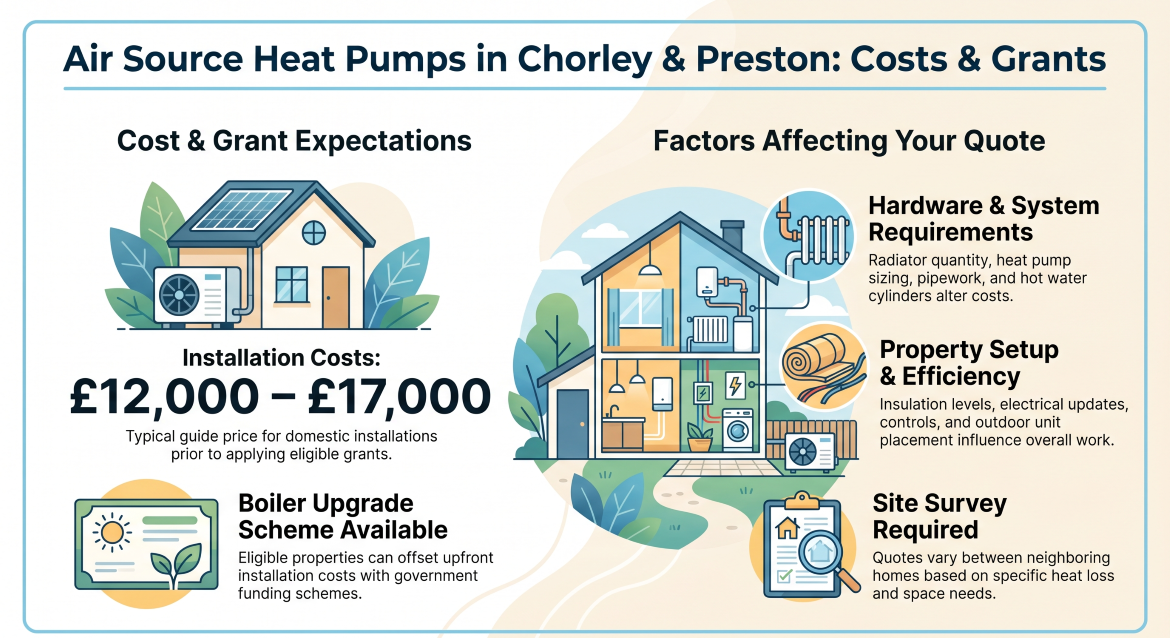
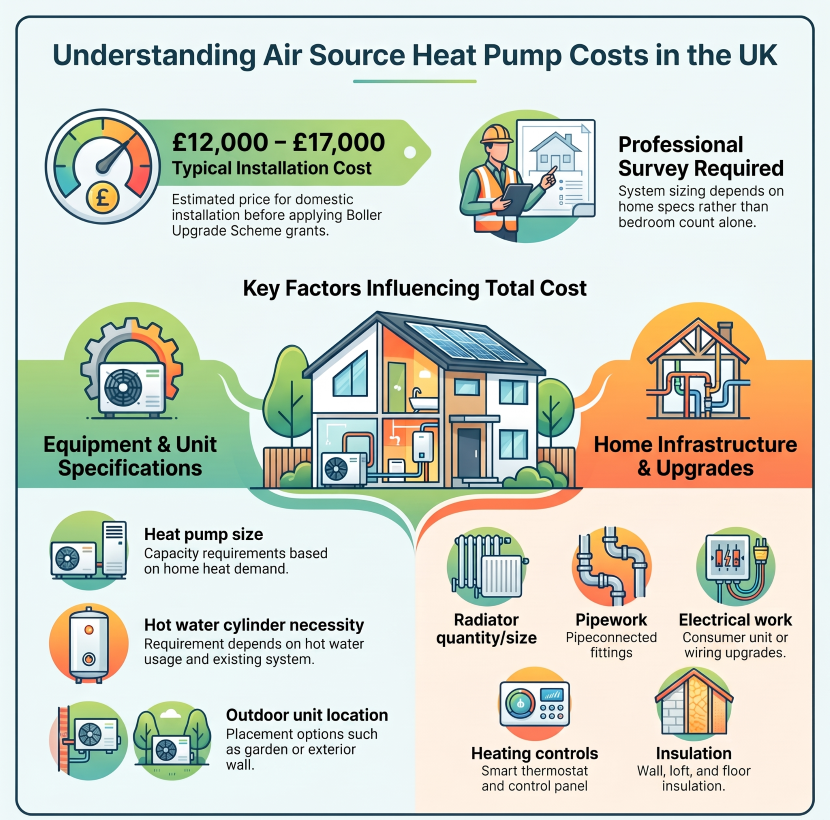
As a general guide, a domestic air source heat pump installation can cost around £12,000-£17,000 before any eligible Boiler Upgrade Scheme grant. The final price varies depending on the property and the work required.
The cost can be affected by:
- The size of the heat pump your home needs
- The number and size of your radiators
- Existing pipework
- Whether you need a hot water cylinder
- Electrical work
- Heating controls
- Insulation improvements
- The location of the outdoor unit
- The amount of installation work involved
So rather than choosing a system based simply on the number of bedrooms, a proper survey is important.
What could you pay after the Boiler Upgrade Scheme?
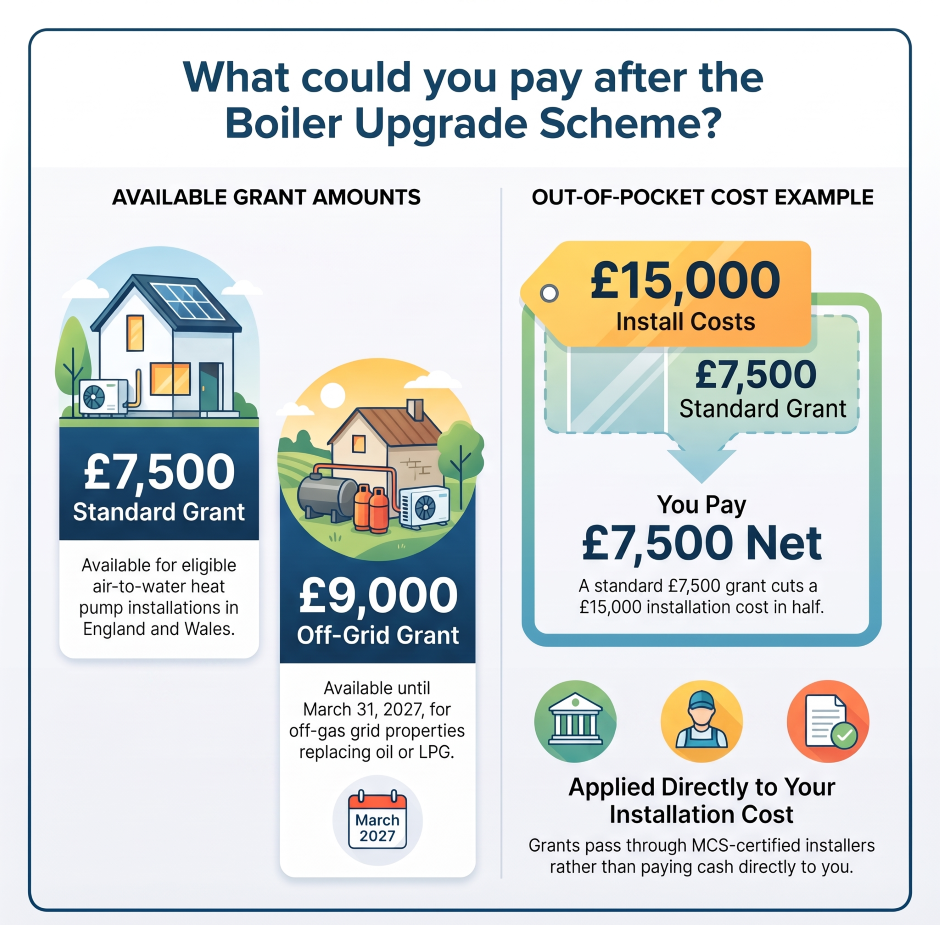
If you qualify, the Boiler Upgrade Scheme (BUS) currently provides a £7,500 grant towards an eligible air-to-water heat pump in England and Wales.
For qualifying properties that are off the gas grid and replacing oil or LPG heating, the grant can be £9,000 until 31 March 2027.
The grant isn’t normally paid directly to you. Through our Alto Assured arrangement, eligible installations can be supported through the appropriate MCS-certified process, with the grant contributing towards the installation cost.
For example, if an eligible installation costs £15,000, a £7,500 grant could reduce the amount you pay to £7,500, subject to meeting the scheme requirements.
Your actual quote could be higher or lower depending on the work your home needs.
Is there 0% VAT on air source heat pumps?
Qualifying residential air source heat pump installations currently benefit from 0% VAT under the government’s VAT relief for eligible energy-saving materials.
The current relief is scheduled to run until 31 March 2027.
Your installer can confirm the applicable VAT treatment as part of your quotation.
Will my existing radiators work with an air source heat pump?
This is one of the most important questions to ask before having a heat pump installed.
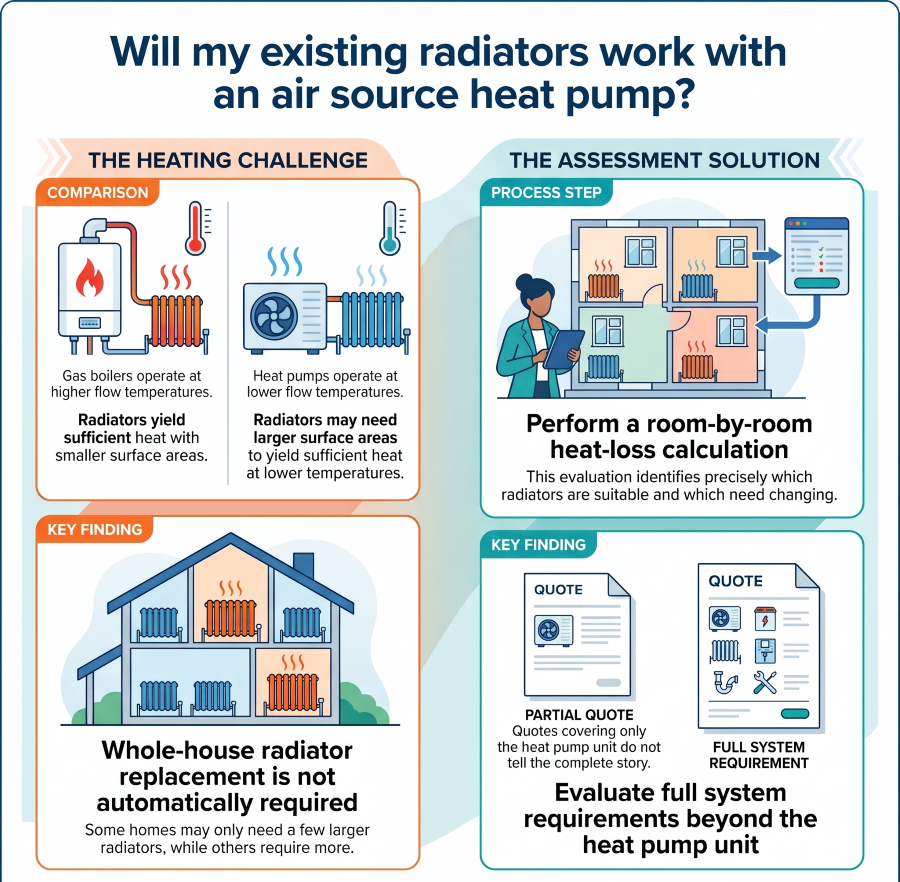
Heat pumps normally operate at lower flow temperatures than traditional gas boilers. This means some existing radiators may need to be larger to provide enough heat at the lower temperature.
But that doesn’t automatically mean you need to replace every radiator.
A room-by-room heat-loss calculation can show which radiators are suitable and which may need changing. Some homes may only need a few larger radiators, while others may need more extensive upgrades.
This is why a quote based only on the heat pump itself doesn’t tell you the whole story.
Can an air source heat pump work with 10mm pipework?
It can, depending on the existing system.
Older homes often have 10mm microbore pipework. Whether it can be retained depends on the system design, required flow rates and individual heating circuits.
In some properties, sections of pipework may need upgrading. In others, the existing installation may be suitable.
It’s much better to identify this during the survey than discover a problem once installation has started.
Do I need underfloor heating?
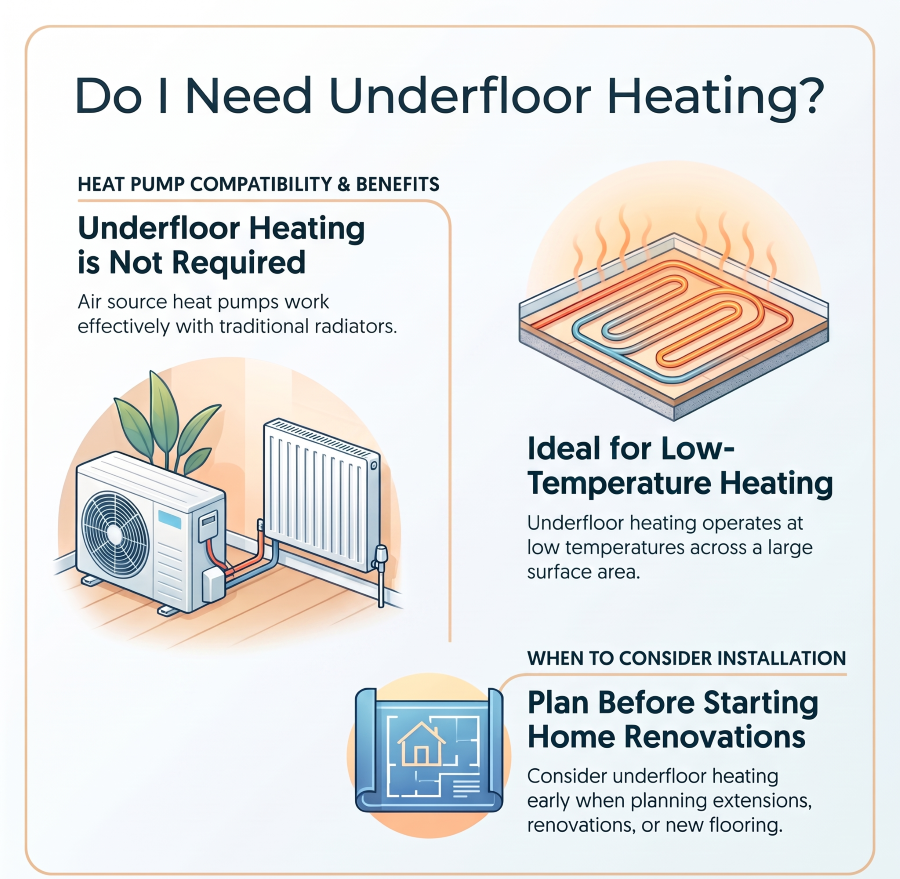
No.
An air source heat pump can work with radiators as well as underfloor heating.
Underfloor heating can be a good match because it operates at relatively low temperatures and provides a large surface area for heat transfer. But you don’t need to install underfloor heating throughout your home just to have a heat pump.
If you’re planning an extension, renovation or new flooring, it’s worth thinking about the heating system before the work starts. For more information on the options, installation and considerations, read our complete guide to underfloor heating.
You can also read more about our underfloor heating service.
What happens during an air source heat pump survey?
A proper survey should look at much more than where the outdoor unit can go.
We would look at:
- Heat loss from each room
- Existing radiators and their heat output
- Pipework
- Hot water requirements
- Insulation
- Heating controls
- Electrical requirements
- Outdoor unit position
- Space for the hot water cylinder
- How the system will be controlled
This helps determine what your property actually needs rather than simply choosing a heat pump based on its size.
Will I need a new hot water cylinder?
If you’re replacing a combi boiler with an air-to-water heat pump that also provides your domestic hot water, you’ll generally need a hot water cylinder.
Unlike a combi boiler, which heats hot water on demand, a cylinder stores hot water ready for use.
That means you’ll need to think about where the cylinder will go and whether you have enough suitable space.
Your installer should discuss this with you before the installation is agreed.
How long does an air source heat pump installation take?
A typical Croston Plumbing air source heat pump and unvented hot water cylinder installation takes around 4 working days.
Where extensive heating pipework or radiator upgrades are required, the work may take up to a further 4 working days.
Every property is different, so the expected timescale will be discussed before work begins.
Are air source heat pumps noisy?
The outdoor unit makes some noise because it has a fan and a compressor.
Modern systems are designed with noise in mind, but the unit’s position still matters. Your installer should consider nearby windows, neighbouring properties, airflow, and the manufacturer’s installation requirements.
Planning rules and permitted development conditions can also apply to domestic air source heat pump installations, so these should be checked before installation.
Will an air source heat pump work in winter?
Yes.
Air source heat pumps are designed to extract heat from outside air even when temperatures are low.
During colder weather, the system may also go through a defrost cycle. Seeing some water or steam around the outdoor unit during this process can be normal.
The more important question is whether the system has been correctly designed for your home’s heat loss.
Will an air source heat pump reduce my heating bills?
There isn’t one saving figure that applies to every home.
Your running costs will depend on your current heating system, electricity tariff, heat demand, insulation, system design, and how the heat pump is operated.
For example, replacing oil or LPG heating is a different situation from replacing a relatively modern gas boiler.
This is why we prefer to look at the individual property rather than promise a particular saving.
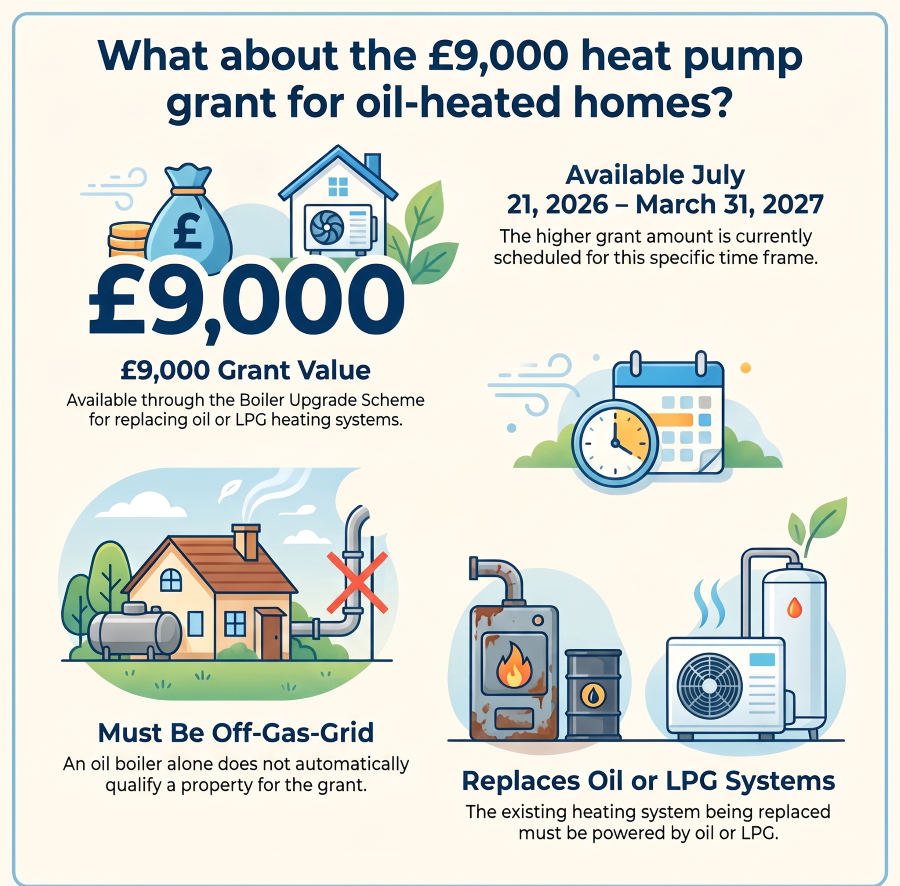
What about the £9,000 heat pump grant for oil-heated homes?
From 21 July 2026, eligible off-gas-grid properties replacing oil or LPG heating can qualify for a £9,000 Boiler Upgrade Scheme grant. The higher grant is currently available until 31 March 2027.
Having an oil boiler alone doesn’t automatically mean you qualify. The property must meet the off-gas-grid requirements and the heating system being replaced must be oil or LPG.
If you’re currently using oil or LPG, it’s worth checking your eligibility before planning your budget around the £9,000 figure.
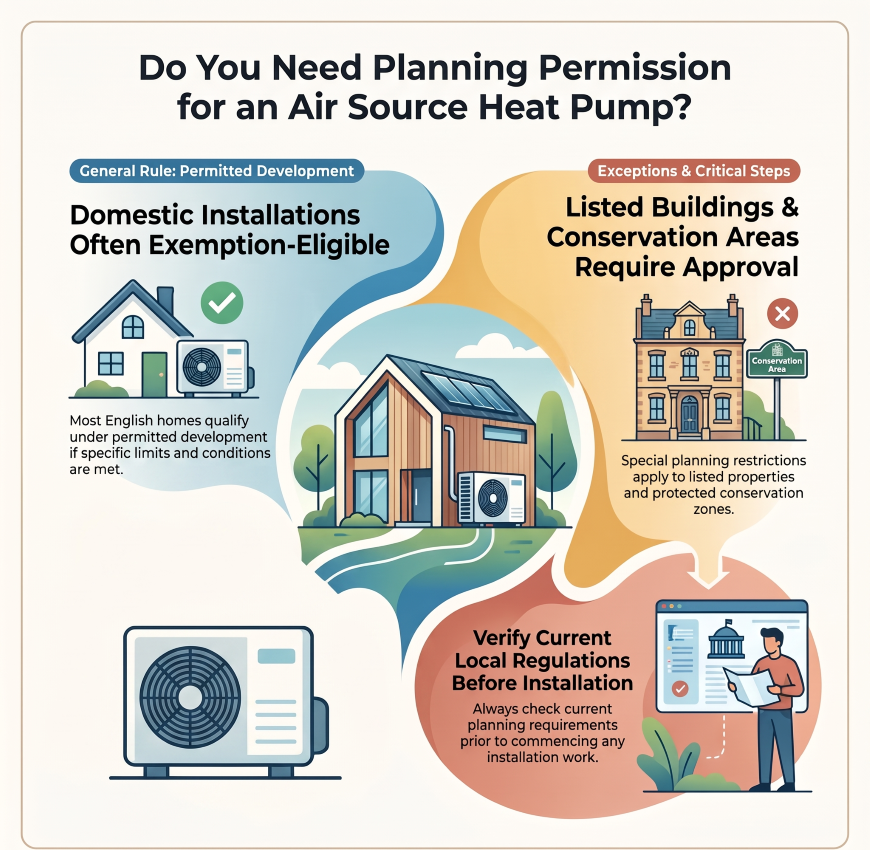
Do I need planning permission for an air source heat pump?
Many domestic air source heat pump installations in England can fall under permitted development, provided the relevant limits and conditions are met.
There are exceptions, including certain listed buildings and properties in areas with additional planning restrictions.
It’s worth checking the current planning requirements before installation, particularly if your property is listed or in a conservation area.
Which homes are suitable for an air source heat pump?
There isn’t one type of home that automatically suits a heat pump.
A heat pump may be considered for:
- Older terraced houses
- Semi-detached homes
- Detached properties
- Bungalows
- Homes with existing radiators
- Homes with underfloor heating
- Properties currently using gas, oil, LPG or other heating systems
Older homes can use air source heat pumps too. The important thing is to assess the property’s heat loss, insulation, radiators, pipework and hot water requirements rather than assuming the age of the property rules it out. For more advice, read our guide to the best heating solutions for older homes.
Air source heat pump installation in Chorley, Preston and nearby areas
At Croston Plumbing & Heating, we look at the complete heating system before recommending an air source heat pump.
That means checking the property, calculating heat requirements and identifying any radiator, pipework or hot water changes that may be needed.
We provide air source heat pump services across Chorley, Preston, Leyland, Bamber Bridge, Eccleston, Croston, Coppull, Fulwood, Longridge, Penwortham, Lostock Hall, Buckshaw Village, Wigan, Ormskirk and Southport.
You can find out more about our air source heat pump installation service or contact us to arrange an assessment.
Frequently Asked Questions
How much does an air source heat pump cost in 2026?
A domestic installation can cost around £12,000-£17,000 before any eligible grant, but prices vary according to the property and work required. An eligible Boiler Upgrade Scheme grant can reduce the upfront cost by £7,500, or £9,000 for qualifying off-gas-grid properties replacing oil or LPG.
Can I keep my existing radiators with a heat pump?
Sometimes. It depends on their size and the heat required by each room. A heat-loss calculation can show whether existing radiators are suitable or need upgrading.
Can I have an air source heat pump with radiators?
Yes. Air-to-water heat pumps can provide heating through radiators as well as underfloor heating.
Can a heat pump replace my combi boiler?
It can, but the system will normally need to be designed differently. If the heat pump also provides hot water, you’ll generally need space for a hot water cylinder.
Do heat pumps work with older houses?
They can. The important thing is to assess the property’s heat loss, insulation, radiators and pipework rather than assuming an older property cannot have a heat pump.
Do I need to replace all my radiators?
Not necessarily. Some homes can keep many of their existing radiators, while others need several larger radiators to work effectively at lower flow temperatures.
Is an air source heat pump suitable for a 3-bedroom house?
It can be, but the number of bedrooms isn’t enough to choose the system size. The heat pump should be sized using the home’s heat-loss requirements.
How long does a heat pump installation take?
A typical installation with an unvented hot water cylinder takes around 4 working days. Where extensive pipework or radiator upgrades are required, the work may take up to a further 4 working days. The exact timescale depends on the property and work required.
Can I get a heat pump grant in Chorley or Preston?
The Boiler Upgrade Scheme applies across England and Wales, so eligible homes in Chorley, Preston and surrounding areas can potentially qualify. The current standard grant is £7,500, with £9,000 available for qualifying off-gas-grid oil or LPG properties until 31 March 2027.
Is a heat pump worth it if I already have a gas boiler?
That depends on your property, existing heating system, energy use and installation cost. A proper survey can help you understand what changes would be needed and what the system could mean for your home.
Thinking about an air source heat pump?
The best place to start is with your home, not a particular heat pump model.
We’ll look at your heating system, radiators, pipework, hot water requirements, and the property’s heat loss before discussing the options with you.
Arrange an air source heat pump assessment with Croston Plumbing & Heating or call 01257 452 879 to discuss your requirements.