Has your Gas Boiler stopped working in freezing temperatures? It could be a frozen condensate pipe!
Every winter, frozen pipes are the number one cause of boiler breakdowns and central heating failure.
When a condensing boiler is operating correctly, condensate water (a byproduct of the combustion process) is created. This water is removed via the condensate pipe, which runs either to an internal pipe (like a sink drain) or your external drain. If this pipe becomes blocked by the water freezing, your boiler may display an error code and stop working.
The good news is that if your issue is a frozen condensate pipe, this can often be easily resolved yourself without the need for an expensive engineer. Follow our simple guide below to learn how to safely defrost a frozen condensate pipe and get your heating back on.
How do I know if the Condensate Pipe is Frozen?
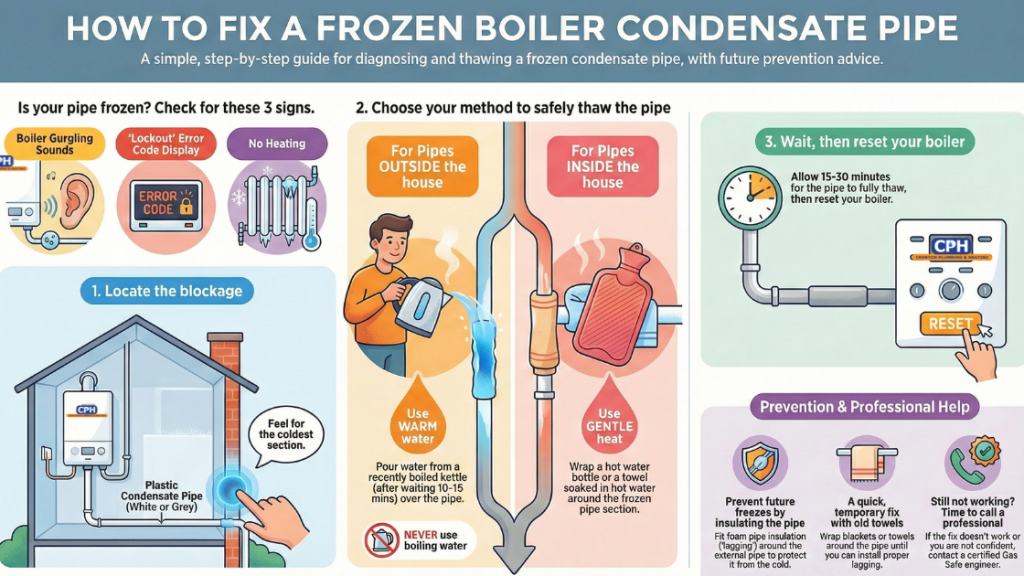
There are three main, easily identifiable signs of a frozen condensate pipe:
- Your central heating is not working (The boiler has stopped firing).
- Your boiler is making a gurgling or slurping sound.
- There is an error code on your boiler display that indicates a blockage or condensate issue (e.g., typically a ‘Lockout’ error).
If your boiler has been working perfectly up until a period of prolonged cold weather or overnight freezing, that is usually a strong indication that your condensate pipe is frozen.
Locating the Condensate Pipe on your Boiler
The condensate pipe is the plastic pipe coming from the bottom of your boiler, leading to either an external drain or an internal drain (like a washing machine or sink waste pipe).
The pipe is always made of plastic (usually white or grey) because the condensate water it disposes of is mildly acidic. The acid would quickly corrode a metal pipe, so plastic is used to keep the pipe intact and prevent leaks.
In most homes, the condensate pipes run to the outside of the house to an external drain.
How to Defrost an External Frozen Condensate Pipe
Follow these steps to safely thaw a frozen pipe outside your home:
- Locate the Frozen Section of Pipe. To find the blockage, feel along the pipe for the coldest section. If your pipe goes outside, it is most likely to be the section of pipe that is exposed to the elements or the final bend/exit point.
- Prepare Warm Water. Boil your kettle, then pour the hot water into a jug or watering can. Wait for 10-15 minutes to let the water cool down so it is very warm, but not boiling. Do not use boiling water as this can damage the plastic pipe.
- Pour the Warm Water onto your pipe. Pour the warm water slowly over the whole length of the exposed pipe, or concentrate on the section where you located the blockage.
- Wait and Check. Leave for approximately 15 minutes. This is to ensure the pipe has fully thawed and the water has been flushed out.
- Reset your Boiler. Once you are confident the pipe is thawed, reset your boiler (refer to your boiler’s manual for the exact procedure, usually a button press). If the heating is back on and the error code is gone, you’re all set! If this hasn’t worked, it’s time to call a heating engineer.
How to Defrost an Internal Frozen Condensate Pipe
If the blockage is inside your home, follow these steps:
- Locate the Frozen Section of Pipe. Follow the condensate pipe from the boiler to where it leads and check to see if it is cold to the touch and likely frozen.
- Boil your kettle and fill a hot water bottle.
- Apply Heat to the Pipe. Wrap the hot water bottle or a thick towel soaked in hot water around the internal pipe. This gentle, steady heat will slowly thaw the frozen water.
- Wait and Reset. Leave the heat source in place for 30 minutes. Once thawed, reset your boiler. If the issue persists, contact a professional.
How to Prevent your Condensate Pipe Freezing Again
The best and most cost-effective long-term solution to prevent your external condensate pipe from freezing is to insulate the pipe.
- Pipe Insulation (Lagging): Foam pipe insulation, or lagging, is a foam tube that fits securely around your pipework. This provides critical insulation against cold weather, helping to prevent pipes freezing. You can source this from a DIY shop like B&Q or Screwfix. Make sure you measure your pipe diameter first to ensure you buy the correct size.
- Quick Fix: For a temporary measure, you can wrap the external condensate pipe in old towels or blankets until you can install proper pipe insulation.
- Relocation/Alteration: For a permanent fix to frequently freezing pipes, you could also consider relocating or altering the position/angle of your condensate pipe to reduce its exposure or to ensure it points downwards at a steeper angle. A heating engineer will be needed for both of these solutions but this may be worth the investment.
When to Contact a Heating Engineer
A certified Gas Safe engineer is needed if:
- The above fix has not worked and your heating is still not working after a few attempts.
- You aren’t confident trying to resolve a frozen condensate pipe on your own.
- The gurgling/slurping noises or the boiler error code persist even after thawing and resetting the boiler.
It’s time to contact a heating engineer!
Croston Plumbing & Heating Ltd are here to help with all your heating needs this Winter. As your local experts in all things heating, we’re here to keep you warm and cosy, year-round. Need to book a visit from one of our engineers? Contact us:
Phone: 01257 452 879 Email: info@crostonplumbing.co.uk
Visit us: Unit G, Grove Mill Industrial Estate Grove Park, The Green Eccleston PR7 5TZ
Mon-Fri: 9-5pm Sat: 9-2pm