Radiators are warm, but the taps are running cold. It’s a frustrating problem, particularly when your boiler appears to be working normally.
If your heating works but you have no hot water, it doesn’t automatically mean you need a new boiler. Your heating and hot water systems rely on different components, so a fault affecting one doesn’t always stop the other from working.
Sometimes the cause is a simple setting that needs checking. In other cases, a component inside the boiler or hot water system may need attention from a qualified heating engineer.
In this guide, we’ll look at seven common reasons why your heating might be working while your hot water isn’t, what you can safely check at home and when it’s time to arrange a professional repair.
Quick Guide: What Could Be Causing the Problem?
The symptoms you’re experiencing can sometimes give you an idea of what might be wrong.
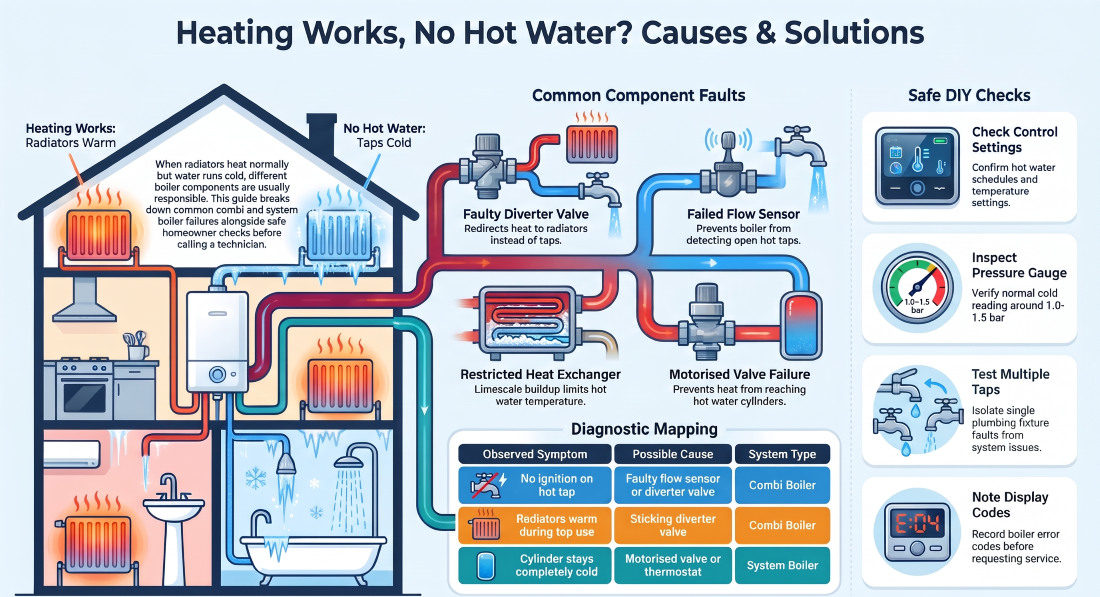
What you notice | Possible cause |
Boiler doesn’t fire when you open a hot tap | Faulty flow sensor or diverter valve |
Radiators warm up when you run a hot tap | Sticking diverter valve |
Hot water is lukewarm or changes temperature | Restricted heat exchanger or faulty temperature sensor |
Hot water cylinder stays cold while radiators work | Programmer, cylinder thermostat or motorised valve |
Hot water only works at certain times | Timer or programmer settings |
These are possible causes rather than definite diagnoses. Several boiler faults can produce similar symptoms, so an engineer may need to inspect the system to identify the actual problem.
Why Is My Heating Working but Not My Hot Water?
The answer partly depends on the type of boiler installed in your home.
A combi boiler heats water directly when you turn on a hot tap. It doesn’t normally need a separate hot water storage cylinder. When you request hot water, the boiler switches from heating your radiators to heating the water supplied to your taps.
A system or conventional boiler, on the other hand, usually works with a separate hot water cylinder. The boiler heats water that is stored in the cylinder, while controls such as the programmer, cylinder thermostat and motorised valves manage when the water is heated.
Because these systems work differently, the cause of a hot water problem can vary. Knowing which type you have can help you explain the symptoms when contacting an engineer.
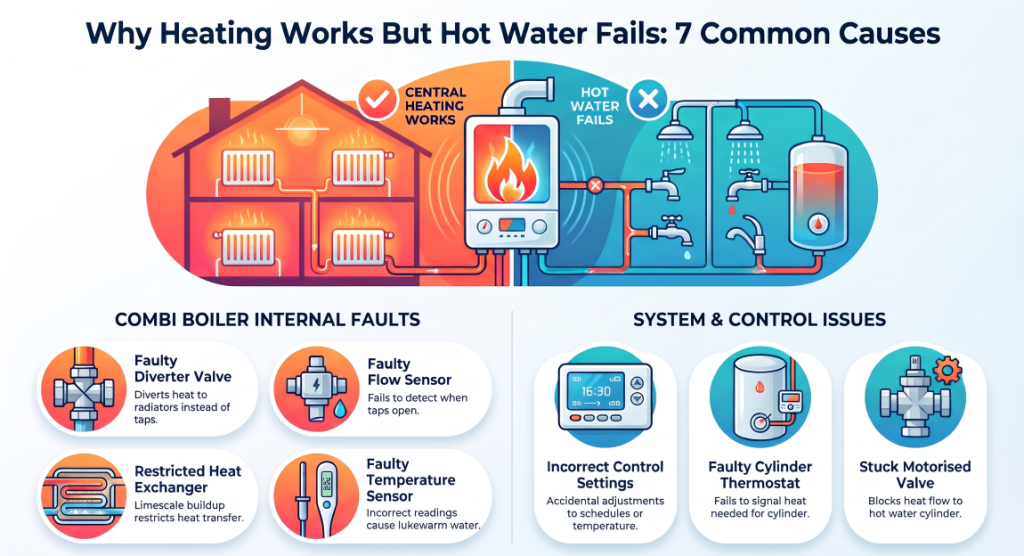
7 Common Reasons Why You Have No Hot Water but Your Heating Works
Faulty Diverter Valve
A diverter valve is an important component in many combi boilers. It directs heated water towards your radiators or your hot water supply, depending on what you need.
If the valve becomes stuck or develops a fault, it may continue sending heat to the radiators instead of directing it towards your taps.
You might notice:
- Your radiators heat up as normal, but the taps stay cold.
- Radiators become warm when you turn on a hot tap.
- Hot water works intermittently or changes unexpectedly.
A faulty diverter valve usually needs to be inspected and repaired or replaced by a Gas Safe registered engineer.
Faulty Flow Sensor
Your combi boiler needs to recognise when someone opens a hot tap. This is the job of the flow sensor.
The sensor detects water moving through the boiler and signals that hot water is needed. If it becomes faulty or stops detecting the flow correctly, the boiler may not start heating the water.
You may notice that the boiler does nothing when you turn on a hot tap, even though the central heating continues to work.
A faulty flow sensor is one possible explanation, but an engineer will need to check the boiler before confirming it.
Restricted Plate Heat Exchanger
Combi boilers use a plate heat exchanger to transfer heat to the water going to your taps.
Over time, limescale or debris can build up inside the heat exchanger, restricting the transfer of heat. This can affect how well your boiler produces hot water.
Common signs include:
- Water that never gets properly hot.
- Hot water temperature that keeps changing.
- Hot water that takes longer than usual to reach the required temperature.
The condition of the heat exchanger will need to be checked by a qualified engineer. Depending on the problem, cleaning or replacing the component may be necessary.
Incorrect Hot Water Settings or Programmer
Before assuming there’s a mechanical fault, check your boiler and heating controls.
Sometimes the hot water settings have been changed accidentally. This can happen after a power cut, a change to the heating schedule or someone adjusting the controls.
If you have a combi boiler, check the hot water temperature setting and make sure the boiler is not in a mode that affects hot water operation.
If you have a system or conventional boiler, check that hot water is switched on at the programmer and that the timings are correct.
It’s a simple check, but it could save you from arranging an unnecessary repair.
Faulty Cylinder Thermostat
If your home has a separate hot water cylinder, the cylinder thermostat controls the temperature of the stored water.
It tells the heating system when the water needs heating. If the thermostat becomes faulty or gives an incorrect reading, it may fail to request heat when needed.
This can leave you with a cold hot water cylinder even though your radiators continue to heat normally.
A heating engineer can check the thermostat and confirm whether it needs adjusting or replacing.
Stuck Motorised Zone Valve
Homes with a hot water cylinder often have motorised valves that control the flow of heated water around the system.
These valves help direct heat towards the radiators or the hot water cylinder. If the valve responsible for the hot water circuit becomes stuck or its motor fails, the cylinder may not receive the heat it needs.
You could find that your radiators are working perfectly while the stored hot water remains cold.
If your cylinder has an electric immersion heater, it may provide a separate way to heat the stored water. Only use it in accordance with the manufacturer’s instructions and any advice provided by your engineer.
Faulty Temperature Sensor
Boilers use temperature sensors to monitor the water inside the appliance and help control its operation.
If a sensor becomes faulty or starts sending incorrect readings, the boiler may struggle to maintain the correct hot water temperature.
You might experience lukewarm water, sudden temperature changes or a fault code appearing on the boiler display.
A qualified engineer can test the sensor and check whether it is responsible for the problem.
What Can You Safely Check Before Calling an Engineer?
There are a few basic things worth checking before arranging a boiler repair. These checks won’t fix every fault, but they may help you identify a simple control issue or give your engineer useful information.
Check the Boiler Display
Look at the boiler display for any warning lights or fault codes. Make a note of the code and check your manufacturer’s manual to see what it means.
Avoid repeatedly resetting the boiler if the same fault keeps returning.
Check the Boiler Pressure
If your boiler has a pressure gauge, check whether the reading is within the range recommended by the manufacturer.
Many sealed heating systems operate at around 1.0-1.5 bar when cold, but the correct pressure can vary between models. Your boiler manual should give the recommended range.
If the pressure is unusually low or keeps dropping, arrange for an engineer to investigate rather than repeatedly topping it up without understanding the cause.
Check Your Hot Water Settings
Make sure the hot water temperature hasn’t been turned down accidentally.
If you have a hot water cylinder, check that the programmer is set to heat the water and that the schedule is correct.
Try More Than One Hot Tap
Check whether the problem affects every hot tap in your home.
If all your hot taps are running cold, the problem may be related to the boiler or hot water system. If only one tap is affected, the issue could be with that tap or its plumbing.
Check Whether the Shower Is Affected
If your taps are producing hot water but your shower is cold, the problem may be with the shower’s own valve or cartridge rather than the boiler.
Checking this can help narrow down where the fault might be.
Read Your Boiler Manual
Your boiler manufacturer’s manual may include basic troubleshooting advice for hot water problems. Follow only the checks intended for homeowners.
Never remove the boiler casing or attempt to repair internal boiler components, gas connections or electrical parts yourself.
If your checks don’t resolve the issue, contact a qualified heating engineer.
When Should You Call a Heating Engineer?
If the heating is working but you still have no hot water after checking the basic settings, it’s worth arranging a professional inspection.
Contact an engineer if:
- The boiler doesn’t respond when you open a hot tap.
- Your hot water keeps turning cold unexpectedly.
- Your hot water cylinder isn’t heating up.
- A fault code keeps appearing on the boiler display.
- You notice unusual noises, leaks or damp around the boiler.
- You suspect a faulty diverter valve, flow sensor or motorised valve.
Some boiler problems are relatively straightforward to repair, while others require further investigation. An engineer can identify the cause and explain the available repair options.
If you’re experiencing ongoing boiler problems, our boiler servicing and repairs service can help identify and resolve common heating and hot water faults. For more information, visit our guide to boiler servicing and repairs in Lancashire to learn about common boiler faults, maintenance and when professional attention may be needed.
Important gas safety advice: If you smell gas, don’t attempt to investigate or repair the appliance. Avoid operating electrical switches, open doors and windows if safe to do so, leave the property and call the National Gas Emergency Service on 0800 111 999.
How Can You Reduce the Risk of Hot Water Problems?
Not every boiler fault can be prevented, but looking after your heating system can help identify potential issues before they become more disruptive.
A few sensible habits include:
- Arrange an annual boiler service: Regular servicing allows a Gas Safe registered engineer to check the appliance and its safety controls.
- Don’t ignore changes in performance: Lukewarm water, fluctuating temperatures or unusual noises are worth investigating.
- Check your heating controls: Make sure the hot water schedule and temperature settings are correct, particularly after a power cut.
- Pay attention to repeated fault codes: If your boiler keeps displaying the same warning, don’t keep resetting it.
- Know which type of system you have: Understanding whether you have a combi boiler or a hot water cylinder can make it easier to explain a problem.
If you are experiencing problems with your central heating as well, our guide to what to check when you have no heating covers some basic checks homeowners can carry out safely before contacting an engineer.
Frequently Asked Questions
Why do I have heating but no hot water?
This usually means that a component or control responsible for producing or directing hot water isn’t working correctly. On a combi boiler, it could be a faulty diverter valve or flow sensor. On a system with a hot water cylinder, the cause could be the programmer, cylinder thermostat or motorised valve.
Why is my boiler heating the radiators but not the shower?
First, check whether your other hot taps are affected. If they are also running cold, the problem may be with the boiler or hot water system. If the shower is the only problem, its valve or cartridge could be faulty.
Can a faulty diverter valve cause no hot water?
Yes. A faulty diverter valve can prevent a combi boiler from directing heat towards the hot water supply. This may leave your radiators working while your taps remain cold. A Gas Safe registered engineer can confirm whether the valve is responsible.
Why does my hot water only work sometimes?
Intermittent hot water can be caused by a sticking diverter valve, faulty flow sensor, restricted heat exchanger or incorrect timer settings. The symptoms can overlap, so the system may need to be inspected to find the exact cause.
Can I keep using my heating if there is no hot water?
It may be possible if the heating is operating normally and there are no signs of a leak, gas problem or other safety issue. However, if the boiler displays a safety warning or behaves unusually, stop using it and contact a qualified engineer.
Why is my hot water cylinder cold when the radiators are working?
A cold cylinder alongside working radiators could indicate an incorrect programmer setting, faulty cylinder thermostat or stuck motorised valve. An engineer can check whether the cylinder is receiving heat correctly.
How much does it cost to fix a boiler with no hot water?
The cost depends on the cause. A simple settings issue may not require a repair, whereas replacing a diverter valve, flow sensor or motorised valve will involve parts and labour. Ask the engineer to diagnose the fault and explain the costs before authorising the work.
Do I need a new boiler if I have no hot water?
Not necessarily. Many hot water problems can be resolved by repairing or replacing an individual component. If your boiler is older, has a history of breakdowns or needs an expensive repair, replacement may be worth considering.
Need Help With a Boiler That Has No Hot Water?
Having heating but no hot water can quickly become inconvenient, especially during the colder months. The important thing is to identify the cause rather than keep adjusting the controls or resetting the boiler and hoping the problem disappears.
Croston Plumbing & Heating provides boiler servicing, repairs and plumbing services across Chorley, Preston, Leyland, Wigan and surrounding areas of Lancashire.
The company is Gas Safe registered (Reg No. 553037), and its engineers can help investigate boiler faults and explain the most suitable next steps.
If your heating is working but your hot water has stopped, contact the team to arrange assistance.
Call 01257 452 879 or visit Croston Plumbing & Heating to get in touch.